
Does Mulch Attract Bugs?
What Homeowners and Landscape Professionals Need to Know
If you have ever mulched a garden bed and then started to wonder whether you just invited every bug in the neighborhood to move in, you are not alone. It is one of the most common concerns we hear from homeowners and landscape professionals at J.A. Rutter Co. The short answer is this: mulch does interact with insects, but the full picture is far more nuanced than the fear suggests, and knowing the facts will help you mulch smarter.
Here is what the research actually says, and what you should be doing to keep your landscapes healthy and pest-free.
Mulch and Insects: Setting the Record Straight
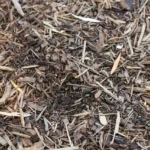
Yes, organic mulch does attract insects. But here is the critical context: the vast majority of those insects are beneficial. According to Nature’s Way Resources, in organic or living mulches, beneficial insects outnumber harmful pest species by 100 to 1 or more.[1] Organic mulches give beneficial insects, such as predatory ground beetles and hunter spiders, a place to shelter during the day while they patrol your garden for pests at night.
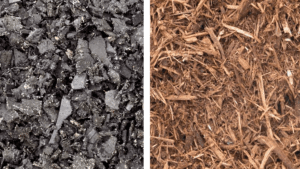
In contrast, inorganic mulches (plastic sheeting, rubber) support a less favorable ratio, sometimes even tipping toward pest species dominance, because they do not support the rich microbial and insect food web that keeps pest populations in check.
The insects that mulch can harbor, including millipedes, sowbugs, centipedes, earwigs, and ground beetles, are largely decomposers and predators. They break down organic material, improve soil structure, and feed on the pests that actually damage plants. Removing them entirely would harm your landscape far more than help it.
The Termite Question: Fact vs. Fear
Termites are the pest that gets the most attention in mulch discussions, and understandably so, given that they cause an estimated $5 billion in property damage nationwide each year. But the relationship between mulch and termites is widely misunderstood.
Iowa State University Extension researchers are clear on this point: there is no evidence that moist mulch conditions attract termite foragers from the surrounding landscape.[2] Termites do not detect your mulch from across the yard and come running. Rather, when termites encounter suitable conditions during their normal foraging, including moisture, cover, and a food source, they are more likely to remain and feed.
The problem is not that mulch summons termites; it is that improperly placed mulch makes it easier for termites already present in your soil to reach your home’s structure.
Iowa State University Extension & University of Maryland Structural IPM ProgramResearch from the University of Florida/IFAS tested six common mulch types, including cypress, eucalyptus, melaleuca, pine bark, pine straw, and utility mulch, and found that termites fed on all of them to varying degrees. Melaleuca mulch was the most resistant to termite feeding, while utility pruning mulch (mixed species) saw the highest termite consumption.[3]
Separate research from the University of Maryland’s Structural IPM Program, conducted in the field around College Park, studied how shredded hardwood, pine bark nuggets, pea gravel, and shredded eucalyptus bark affected foraging patterns of subterranean termites.[6]
The environmental conditions mulch creates, specifically retained moisture and insulated soil temperatures, matter far more than what the mulch is made of.
University of Maryland Structural IPM Program — Field Research, College Park, MDUniversity of Florida research also found that termites rarely survive commercial mulch production, because the heat generated during processing is lethal to them.[3]
The risk is not termites traveling in your mulch delivery; it is the conditions mulch creates adjacent to your foundation once it is installed.
University of Florida / IFAS ExtensionThe Real Problem: Installation Errors, Not Mulch Itself
Across university research and extension guidance from Penn State, Iowa State, and the University of Florida, one theme emerges consistently: insect problems attributed to mulch are almost always the result of how mulch is applied, not the fact that it was applied.
Insect problems attributed to mulch are almost always the result of how mulch is applied, not the fact that it was applied.
Penn State Extension, Iowa State University & University of Florida — Extension Research ConsensusThe most common installation mistakes that create pest problems:
- 1 Applying mulch too deep. Penn State Extension recommends no more than 2 to 3 inches of mulch for landscape beds.[4] Thick, wet mulch heats up as it decomposes, with internal temperatures reaching as high as 140 degrees Fahrenheit, and creates an ideal environment for moisture-loving insects such as carpenter ants and termites. Deep mulch also promotes rot in tree trunks and root zones.
- 2 Piling mulch against tree trunks — sometimes called “volcano mulching.” According to Penn State Extension, mulch piled against the trunk favors moisture-loving insects that can colonize and expand decayed areas of the wood.[4] Rodents such as voles and mice also tunnel under deep mulch and gnaw on the inner bark, sometimes girdling and killing young trees.
- 3 Placing mulch directly against the home’s foundation. The University of Florida/IFAS Extension specifies keeping at least a 12-inch zone adjacent to the foundation free of mulch or other ground covers.[3] This creates a dry inspection zone that termites are unlikely to cross and allows visual detection of mud tubes. Building codes in many jurisdictions also require a 6-inch gap between mulch and siding.
- 4 Adding new mulch on top of old without checking depth. Old mulch compacts over time. Landscape professionals should check depth before each application and remove or redistribute excess before adding a fresh layer. Raking and breaking up matted layers also improves airflow and reduces moisture retention.
- 5 Using unfinished or partially decomposed compost mulch near foundations. This type of material generates heat and attracts decomposer insects in higher numbers. Well-cured compost mulch is low-risk and provides excellent soil benefits.
Which Mulch Types Are Lower Risk for Pest Problems?
Mulch type matters, especially for applications near structures. Here is how common options compare based on available research:
Hardwood Bark Mulch
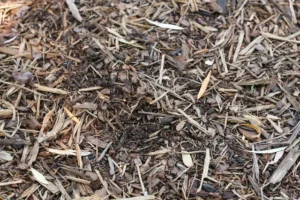
J.A. Rutter’s double-shredded hardwood bark is produced from locally sourced hardwoods, decomposes to enrich soil over time, and when properly applied at 2 to 3 inches, supports a healthy beneficial insect community. Keep it away from foundations and avoid burying root flares.
Colored Wood Mulch
J.A. Rutter’s colored mulch, including Cherry Brown, Black, Dark Brown, Red, and Saffron, is manufactured on-site from high-quality recycled materials using non-toxic colorants. Pest interaction depends entirely on application depth and placement, not the color or dye.
Compost & Organic Blends
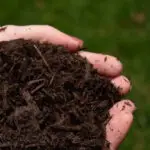
Well-cured compost mulch carries an extra benefit: high levels of beneficial microbes tend to parasitize termite larvae, making composted mulches less hospitable to termite establishment than raw wood chips.[1] See Rutter’s organic line.
Cedar Mulch
Cedar’s natural oils repel ants, moths, mosquitoes, and carpet beetles.[8] Best reserved for areas where pest control is the priority, such as along foundation perimeters, rather than planting beds where microbial activity matters.
Stone & Gravel
Stone and pea gravel eliminate organic food sources, making them the lowest-risk choice for termite feeding. However, a University of Florida study found favorable moisture conditions persist regardless of mulch type — and stone does not improve soil health.[3]
Mulch Also Protects Against Pests
The insect conversation around mulch tends to focus exclusively on risk, but research shows mulch can actively reduce certain pest problems. A study cited by Nature’s Way Resources found that damage from Colorado potato beetles was 2.5 times higher in un-mulched garden plots compared to mulched ones, because straw mulch supported populations of larval predators that kept pest beetles in check.[1]
Penn State Extension’s Integrated Pest Management (IPM) guidelines note that only 3 to 5 percent of insect species are actually harmful, and that most pests have natural enemies, including birds, toads, and beneficial insects, to keep them in check.[5] A well-mulched landscape that supports these natural predators is a more resilient, lower-maintenance landscape.
Best Practices: How to Mulch Without Creating Pest Problems
Whether you are a homeowner putting down a few yards in your flower beds, or a landscape contractor managing dozens of commercial accounts, these guidelines, drawn from Penn State Extension, the University of Florida/IFAS, Iowa State University, and the University of Maryland, represent the current research consensus:
- Apply 2 to 3 inches deep. This is enough to suppress weeds and retain moisture without creating the anaerobic, pest-hospitable conditions that come with deeper applications.[4]
- Keep a 12-inch bare zone at the foundation. University of Florida/IFAS Extension is explicit: no mulch, or at most a 1-inch layer, within 12 inches of the foundation. This gap also allows you or a pest control professional to spot mud tubes during routine inspection.[3]
- Keep mulch away from tree trunks. Pull mulch 3 to 5 inches from young trees and 8 to 10 inches from mature trees, exposing the root flare. Penn State Extension notes that trees often show rapid improvement in color and vigor once buried root flares are uncovered.[4]
- Check depth before every seasonal refresh. Rake and break up old compacted mulch before adding new material. If you are already at 3 inches, you may only need to turn what is there rather than adding a full new layer.
- Ensure proper drainage and grading. Iowa State University and the University of Florida both emphasize that moisture management matters as much as mulch type. Grade your landscape to direct water away from the foundation with at least a 5 percent slope for the first 10 feet, ensure gutters discharge at least 6 feet from the foundation, and keep irrigation heads at least 1 foot from exterior walls.[2]
- Use well-cured, locally sourced mulch. J.A. Rutter’s products are manufactured on-site in Monroeville, not transported from unknown sources, allowing consistent quality control. Locally processed mulch has gone through the heat cycle of production, significantly reducing the likelihood of viable pest populations in the product itself.
The Bottom Line
Mulch does not cause insect infestations. Improperly applied mulch, whether too deep, too close to structures, or piled against tree trunks, creates conditions that can worsen existing insect problems. Apply mulch correctly, choose a quality product, and you get all the benefits: moisture retention, weed suppression, soil temperature moderation, improved soil health, and a healthier landscape ecosystem.
At J.A. Rutter Co., we have been producing landscape supplies in western Pennsylvania since 1972. Our mulch is locally sourced, manufactured on-site, and sold by weight, so you know exactly what you are getting.
Browse Our Mulch Call (724) 327-1101 Visit Our YardSources & Citations
- Nature’s Way Resources. Insects, Pest and Disease Associated With Mulch. natureswayresources.com
- Iowa State University Extension and Outreach. Does landscape mulch lead to termites in your home? Yard and Garden. yardandgarden.extension.iastate.edu
- University of Florida/IFAS Extension, Pinellas County. Termites and Mulch. blogs.ifas.ufl.edu
- Penn State Extension. Mulching Landscape Trees. Vincent Cotrone, David R. Jackson. extension.psu.edu
- Penn State Extension. Creating Healthy Landscapes. IPM / Plant Health Care guidelines. extension.psu.edu
- University of Maryland Structural IPM Program / Pest Control Technology. Termites & Mulch. pctonline.com
- EcoGuard Pest Management. Does Mulch Attract Termites? Complete Guide to Safe Mulching. ecoguardpestmanagement.com
- Davey Tree Expert Company. What Mulch is Best for Repelling Bugs? blog.davey.com
- Devonian Landscape. Does Mulch Attract Bugs? devonianlandscape.com
- NCBI/PMC. Organic Mulch Increases Insect Herbivory by the Flea Beetle Species, Disonycha glabrata, on Amaranthus spp. MDPI/PMC, 2020. ncbi.nlm.nih.gov
- J.A. Rutter Co. About Us & Mulch Product Pages. jarutter.com